| Cultural controls The first rule for managing most cocoa pests is to grow a healthy crop (e.g. apply fertiliser to replace soil nutrients). Basic good agricultural practices (GAP) include: - weeding, shade management, removal of mistletoe, etc.;
- do not let trees grow too tall and maintain a suitable tree height; there are various techniques for rehabilitating trees, but they usually involve substantial loss of crop over 2-3 seasons;
- harvest pods as regularly as possible and note: there is a difference in emphasis between sanitary harvesting and regular complete harvesting (recommended for the severest problems such as FPR and CPB);
- destroy infected/infested crop residues;
- consider avoiding nearby trees that act as alternative hosts (e.g. kola trees in Africa that may encourage mirids and P. megakarya; in Asia CPB also feeds on rambutan).
| Cocoa tree rehabilitation in Ecuador |
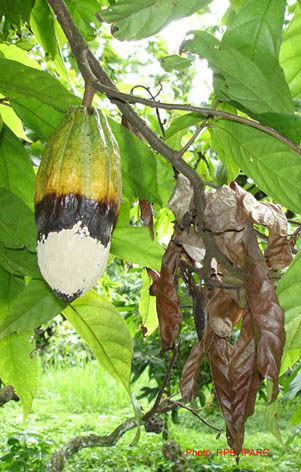
| Black pod: Phytophthora spp. 
The picture above was taken in Ghana, where fortunately, beans may sometimes be extracted from pods showing disease sypmtoms on the outside – unlike Moniliophthora diseased pods
(see below).
| The disease - Some of the cultural methods listed above are essential. Poor aeration within the crop canopy may encourage the disease, so thinning the canopy can help. Fungicides will only work well in combination with appropriate good tree height and canopy management facilitates pod inspections.
- Remove soil on cocoa trunks: soil tunnels built by ants on the surface of cocoa trunks must be removed. This eliminates two sources of disease: spores carried in infested soil and those carried by the ants themselves.
- Apply appropriate fungicides using correct application methods. Copper compounds and metalaxyl are widely available fungicides that are effective.
- Soil health and general good crop management are essential. Soils contain nutrients for the cocoa trees, but also can harbour the pathogen. Soils with high organic matter and good drainage help prevent inoculum splashing and spreading in puddles of water.
- The hyperparasite Trichoderma asperellum appears to be the most promising biological control agent found to date.
- Cankers have been successfully treated by trunk injection of potassium phosphonate.
|
|
Invasive Moniliophthora diseases:
Witches’ broom M. (Crinipellis) perniciosa

| The diseases
Frosty pod rot (FPR) M. roreri
These pictureshow that with Moniliophthora diseased pods, outside lesions may appear less serious than bean loss.
 |
| |  | - Maintain canopy height and structure – annual pruning (usually once in the dry season) helps control brooms
- Recognise early symptoms (and note FPR affects other Theobroma spp.)
- Management practices to ensure yield and improve natural resistance from trees (shade management, weeding, chupon removal and fertilization).
- Fortnightly removal of infected pods during the epidemic season to prevent FPR from sporulation and reduce inoculum pressure
- Spraying: from peak of flowering then perhaps 3 months (up to 6 applications of fungicides) for pod protection. Applications of protectant fungicides, especially copper, are known to reduce disease incidence and increase yield: chlorthalonil is more toxic. Good application methods for chemical and biological control agents are essential.
- In the long term: it is important not to spread infected material from one region to another. Resistant varieties may become available, but potentially useful genotypes are very limited.
The picture on the left was taken in Ecuador where the two Moniliophthora diseases occur – and must be managed – together. |
| Other cocoa pod diseases | The diseasesThese are rarely severe enough to warrant control measures other than standard cultural methods (see above). |
| Insect-borne viruses:
Cococa Swollen Shoot Virus Disease (CSSVD)
| The diseases and vectors - Remove diseased trees as well as their neighbouring cocoa trees (that might look healthy, but are expected to be infected with the virus). This works for small outbreaks. When more than 100 trees in any one area are diseased, adjacent cocoa trees up to 15 m away with disease symptoms should be removed.
- Alternative methods include using resistant cocoa trees when replanting cocoa. Check with your local cocoa research institute and find out about resistant varieties.
- When establishing new cocoa farms, where possible, plant trees away from known CSSV areas. Use natural barriers, such as are oil palm, coffee and citrus to prevent or slow-down the spread of the mealy bugs within cocoa farms.
- Use of systemic organophosphate insecticides was tested to control mealy bugs was hazardous and had little effect; insecticides are not currently recommended.
|
| Vascular streak die-back (VSD):
Oncobasidium theobromae | The disease - There is some scope for host plant resistance – refer to your local breeding programme.
- Protection of seedlings is especially crucial.
- When symptoms are found at an early stage in more mature trees, hard pruning well beyond the infected parts of a branch and destruction (preferably burning) of removed plant material may be effective.
- Fungicides are probably not cost effective for wide-scale spraying of mature trees, and are used mostly for protecting seedlings, using triazole compounds such as tebuconazole, triadimefon and triadimenol.
|
| Root diseases (causing tree death) | The diseases When trees become infected with diseases such as Ceratocystis, and especially when Xyleborus beetle holes (indicated by arrow: note frass below) are found, the most effective course of action is to uproot trees and burn infected plant material. No cocoa varieties have yet been found that are tolerant to Roslinia spp. Short of this, dispose of infected branches before beetles appear and before the fungus has a chance to sporulate on the cut ends of branches and stumps. Wound treatments with tree paints or protectant fungicide pastes on uninfected trees may also help control the disease. |
| Sucking insects: Helopeltis spp. 
H. antonii (Java)
West African mirids (capsids):  
Distantiella Sahlbergella singularis
theobroma adult (3rd instar nymph)
| The insect pests - Maintain a complete canopy: in young plantings, temporary shading is needed, e.g. with bananas and plantains.
- Remove chupons regularly: mirids are attracted to the young and soft shoots that cocoa trees grow throughout the season. Chupons that emerge at the base of trees should be removed regularly, not just during the peak mirid season. Do not prune too heavily as this will stress the trees and cause the growth of new chupons, which increase mirid feeding.
- All cocoa varieties are affected by mirids, but modern ones less so than Amelonado (possibly tolerance to infections of Calonectria rigidiuscula and other mirid transmitted fungi that may cause cocoa dieback). Improved varieties have been offset by changes to the agricultural environment: a trend towards reduced shade encourages mirids.
- Insecticides are widely used and effective: especially when timed correctly (often early in the season). If possible, only spray those areas in the farm that are attacked by mirids (spot application). Careful and well-timed application can help farmers to save money by using less insecticide, and decrease impact on natural enemies of this pest.
In the past, organochlorine insecticides (e.g. lindane, endosulfan) and carbamates (propoxur and promecarb) have been chosen with vapour action and persistence to counteract poor application. Many of these have been, or are in the process of being, withdrawn.
Modern, less toxic insecticides, such as neonicatinoids, are now available, but these are expensive and not always available. Pyrethroids can be effective, but they may kill beneficial insects such as pollinators, so these must only be used as little as possible and only where mirids actually occur.
Note: some insecticide products are mixtures, e.g.:
profenfos + lambda-cyhalothrin – ‘Gammalin Super’
endosulfan + deltamethrin – ‘Cracker’
pirimiphos methyl + bifenthrin – ‘Talstar’, ‘Cocostar’ - Two lines of research that especially show potential and may be useful in the future:
– mirid pheromones
– mycoinsecticides
For the latter, we are currently searching for isolates.
|
| Cocoa pod borer (CPB)
Conopomorpha crammerella

Cocoa husks temporarily covered with plastic sheet to prevent CPB hatching (PRIMA, Sulawesi)
| The insect pest - Regular complete harvesting of pods is almost certainly the most effective cultural technique.
- Other cultural techniques include: rampassan (enforcing a break in pod production) and removal/burying/enclosing husks (below left)
- Historically, chemical control has been most effective with broad spectrum insecticides. These originally included organochlorines (e.g. gamma-HCH or endosulfan) that have now been – or are in the process of being – withdrawn for safety and environmental reasons. Farmers in Sulawesi are left with a choice between oganophosphates (e.g. chlorpyrifos) and pyrethroids (e.g. cypermethrin, deltamethrin, lambda-cyhalothrin) and fipronil (similar mode of action to organochlorines).
- This situation is not satisfactory, and collaborative research is currently underway to investigate alternative, safer, effective, but more environmentally sound products such as insect growth regulators, but these appear to be less effective and more expensive than neurotoxic insecticides.
Potentially important lines of research and development:
– pheromones: for monitoring
(possibly mass trapping / mating disruption);
– sleeving (preferably with biodegradable plastics – below). - Attempts at biological control have proved disappointing to date.
 |
| Stemborers  
| The insect pests - Maintain a healthy and balanced ecosystem to preserve natural enemies that kill lepidopteran stem borer caterpillars. Use pesticides rationally to keep insect pests in check and to preserve natural enemies of stem borer.
- Plant a barrier crop that is not attractive to stem borers, such as: Leucaena glauca, cocoyam, sweet potato or Pueraria species. The barrier must be at least 15 m wide and established early for new plantings.
- It has been suggested that attacks have been caused by heavy pesticide use on trees, which kills off the natural enemies (insecticide resurgence). However, from the 1990s onwards, stem borer has become more noticeable, even on farms where no pesticides are used.
- In Papua New Guinea, stemborers and associated Phytophthora cankers can kill up to 2% of cocoa trees annually, so they have been controlled by applying oganophosphates with fumigant action (e.g. DDVP) mixed with a fungicide such as metalxyl.
|
| Rodents and other vertebrate pests 

| The vermin - Rat traps and nooses are popular, but of little value for lowering populations: a combination of good practices is most likely to be successful. These must be implemented over large areas as rodents reproduce and spread quickly. Whole communities should work together, if possible.
- Good farm management (weeding, light shade management, timely pruning, etc.) is important.
- Barn owls are probably the most proven biological controls for rodents. When barn owl nest boxes were established in cocoa plantations in Malaysia, rat damage was significantly reduced. Recently a control product has been brought out based on the pathogen Sarcocystis singaporensis
- When rodents attack more than 4 out of 100 cocoa pods, farmers may want to think about chemical control. Rodents can be baited and killed with poisoned wax blocks (containing the anti-coagulants: brodifacoum, bromadiolone or warfarin), tied high up on trees to help avoid poisoning of children and farm animals. Baiting with anti-coagulant rodenticides is most likely to work when farmers co-operate and treat as large an area as possible at the same time – best in the low season when rodents are most hungry. Another problem is that rats adapt and learn quickly not to eat the poison (bait shyness).
|
| Mistletoes At least 6 different species of Mistletoe have been found on West African cocoa. One species Tapinanthus bangwensis accounts for about 70% of infestations in Ghana and is recognised by its red flowers and berries: it flowers twice a year and can live for up to 18 years. Regular removal of mistletoe is essential for good crop management and in healthy cocoa crops, misletoes are not able to become established; large populations can be considered a sign of farm neglect. Mistletoe may also provide a suitable habitat for ants (Crematogaster sp.) which cultivate the mealybugs vectors of CSSVD. | |